Studying Health Science at UK Universities

A health science degree in the UK is a multidisciplinary degree that will prepare you for a variety of healthcare vocations. If you’ve considered a career in medicine and enjoy learning how health and wellness can be applied to everyday life to improve your quality of life, a health science degree might be right for you. A health science major is an interdisciplinary degree that applies science to human and animal health, such as medicine, nutrition, and other related fields. A health science major will provide you with the knowledge and abilities needed to work in a range of healthcare positions.

Health Science Degrees

The following are some of the fundamental criteria for each level of a health science degree:

  1. Associates: A two-year degree allows you to begin working sooner than others who choose to continue their education. It will offer doors to jobs in administration, health informatics, health science writing, and laboratory technology.
  2. Bachelor: Full-time completion of a bachelor’s degree usually takes four years. It will allow you to either pursue a general position in the healthcare profession or allow you to specialize in advanced patient care, nuclear medicine, biomedical sciences, global health, child health, and other areas. Health, Safety, and Ethics, Healthcare Informatics, Financial Management in Healthcare, and others are among the courses available.
  3. Masters: It takes 18-24 months to finish a Master’s in study health in the UK degree. You can continue your education beyond a Bachelor’s degree to earn a Master’s degree, which will boost your pay potential and allow you to work in management and leadership positions in the sector.
  4. Doctorate: A Doctor of Health Science, or D.H.Sc., is a post-professional academic degree designed for persons who want to enhance their careers in education, research, administration, or practice. It opens doors to jobs of leadership and teaching.

Benefits of Studying Health Science

There are numerous advantages to taking a health science course. The following are a few of them:

  1. Lucrative Salary: Earning a solid living after completing a bachelor’s degree in health-related courses in the UK. There are numerous occupations to pursue, and we’ll discuss a few of them here: health instructor, lab manager, lab assistant, health organizer, and many others. Pay varies depending on the position.
  2. Good Working Field: In this industry, the number of work opportunities is expected to skyrocket. In this field, we’re talking about a rough estimate of job hikes. There will be a 30 per cent increase in inpatient teachings and a 20 per cent increase in medical labs and other offices.
  3. Flexible Job Field: This career allows you more flexibility, making it a good overall package. We can work as health care providers treating patients on the ground level, or as a teacher in various universities and colleges instructing students. On the other hand, when it comes to the creative field, you can choose from science writings, writing articles for various newspapers and magazines, medical photography, bio illustration, and so on. These options provide you with the freedom to change jobs at any time during your career.
  4. Knowledge about Human Body: Our bodies are the most advanced machines on the planet. It’s a fascinating subject to investigate. You can investigate this lovely machine. You will find this entertaining and informative. You have a good understanding of your body’s mechanics and basic demands.

Universities Offer Health Science in the UK

  1. Middlesex University London: Their program prepares you to work as a public health practitioner by providing you with a solid foundation of theoretical and practical knowledge and skills that will help you transition smoothly into the field. Mental health, ageing, water and sanitation, and public health regulation are among the specialities of our group. The university has a great research reputation, making it an excellent environment for you to conduct your own groundbreaking study.
  2. Nottingham Trent University: Their Master of Public Health program was developed in response to ongoing international debates about the shifting nature and boundaries of multidisciplinary public health. It will enable you to gain a broad understanding of public health while maintaining a critical awareness of the discipline’s philosophical, theoretical, and methodological aspects, and you will be enthusiastic about the possibility of acting as change agents in multidisciplinary public health settings after graduation.
  3. University of Essex: Essex has a wealth of methodological, disciplinary, and subject-area knowledge. This course will prepare you to analyze and assist in the formulation and implementation of evidence-based and rights-based public health policies and programs at the local, national, and global levels.

In the end, growing demand for health care in the UK, combined with budget cuts, has resulted in a rising demand for a qualified and effective public health staff. The field of public health is constantly evolving, particularly as the population ages, necessitating an increase in the number of public health specialists on hand. 

Student Finance in the UK

It’s difficult to get your head around student finance in the UK, and finding everything you need to know in one place isn’t always straightforward. When you’re making plans for the future, it’s crucial to know what options you have, how you’ll pay for your studies, and when you’ll have to start repaying any debt. So, there you have it: all you need to know about student debt. The Student Loans Company offers a service called Student Finance England (SFE). They give financial assistance to students of both undergraduate and postgraduate in the UK on behalf of the UK government.

Types of Student Finance in the UK

Student finance is government funding that you can apply for to help pay for university tuition and living expenses while you’re studying. According to UCAS, tuition fees cover major aspects of your course and academic life (lectures, seminars, and tutorials, course administration costs, access to course-related facilities, and so on), as well as core services relevant to students’ wellness. The loans for students in the UK are as followed:

  • Tuition Fees: Tuition fees are charged by universities to pay the costs of administering undergraduate programmes. They can also account for costs associated with registration, supervision, tests, and graduation. Because tuition fees vary depending on where you live, universities must first conduct an evaluation to evaluate your eligibility. Only universities that do well in a new teaching quality evaluation will be able to increase their fees, according to the Teaching Excellence Framework (TEF), which was introduced in 2017. Students from Scotland do not have to pay tuition at Scottish universities. 
  • Living Costs: Whether you live in halls of residence or privately rented property, your rent is likely to be your most important living expense. You should thoroughly investigate your student housing alternatives. You’ll need to budget for any extra expenses that aren’t included by your rent, such as Wi-Fi, as well as necessities like food. Remember to budget for insurance, clothing, toiletries, books, course materials, printing, local and international transportation, and social activities. However, you do not have to pay council tax if you reside in a student house where everyone is studying full-time.
  • Student Loans: If you want to study for one of the following credentials, there is financial assistance available to help with the costs:
  • Undergraduate Degree (BA/ BSc etc.)
  • Foundation Degree
  • Certificate of Higher Education
  • Diploma of Higher Education
  • Higher National Certificate
  • Higher National Diploma
  • Initial Teacher Training Course

Procedure to Apply for Student Finance

As student loan applications might take up to six weeks to process, you should apply for your loan by May 31 if your course begins between August 1 and December 31. Before applying for student finance for UK undergraduate in 2022 you do not need to have a confirmed offer of a seat on a course. The financing deadline for your course is nine months from the start of the academic year. Students in England can use Student Finance England to register and apply for funding. You may track your application here, as well as check your student finance payment dates and make any necessary changes to your information.

How to Repay Student Loan

On student loans, interest is calculated using the retail price index (RPI) plus up to 3%. You don’t have to pay back these loans until April of the following year if you graduate or leave your course and earn £27,288 or more per year (£2,274 per month) before taxes and other deductions. After that, you’ll make repayments at a rate of 9% of your income above the threshold. If you want to pay off any or all of your loans outside of this payback period, there are no penalties.

The Process to Cancel Student Finance

If your plans change before the start of your studies, you can update or cancel your funding application. You’ll need to contact Student Finance England or the appropriate administrative entity to finish this. As a full-time student who generally resides in England, Wales, or Northern Ireland, you will still be liable for 25% of your tuition price loan if you withdraw, transfer, or cease your studies after the first term of the university has begun.

Finally, contact your university to discover more about what’s offered, if you’re eligible, and how to apply. In the meanwhile, if you run into financial difficulties after starting your studies, your university may be able to assist you with funds from its hardship reserves. 

MBA Application in the UK

A business degree from a UK institution is one of the most popular degrees around the world, as it teaches students about the planning, operating, and operations of a company. Students are exposed to various facets of the business sector, including marketing, finance, human resource management, and administration. While the initial stage consists of an overview of the entire business world, students might choose to specialize in one of the business disciplines at a later level.

Admission Requirement for MBA Degree: Students must meet the following fundamental eligibility criteria in order to enrol in a business course in the United Kingdom:

➢    An appropriate three four-year bachelor’s degree from a recognized university, which is equivalent to a UK bachelor’s degree

➢    Some ranking UK universities may need a minimum of one year of work experience.

➢    With a decent result on the IELTS / TOEFL exam, you can meet the criteria of English language competency.

We’ve sprinkled a little magic to help your MBA application thrive, based on advice from us and industry veterans who deal with MBA applications on a regular basis.

  1. Application Form: Send your inquiries at least 12 months before your intended entrance date. On the university’s website, you can request application forms. To request application materials, most colleges provide a form on their website that may be filled out online. The majority of universities have representation in a variety of nations. These representatives will provide you with application forms and will also assist you with the application procedure.
  2. Educational Record: The applications must include complete information about your education, including course subjects and grades. For your application, you will need transcripts or official documents of your previous academic achievements. Students seeking admission must present an official transcript from each institution or university they have attended after high school, detailing all subjects studied, credits earned, and other information such as correspondence courses, diplomas, and so on.

3.     Make Sure You’re the Right Fit: Before attempting to persuade the reader that you are the best fit for the MBA programme they are providing, you should conduct some research and analysis. The institution will evaluate your application to see if you share its standards, ethics, and values. On the contrary, you should apply if the university to which you are applying values your morality. After you have a good understanding of what the university is all about, you will have a lot of information to frame a response to the most important question.

4. Recommendation Letter: Reference letters, also known as recommendation letters, are extremely significant in gaining admission to a top MBA programme. A recommendation letter is a signed statement from someone who knows you professionally or has taught you on a topic related to the course to which you are applying. It should include a list of your good and negative characteristics, as well as your strengths and other relevant information.

The author or teacher must state his or her position, as well as how long and in what capacity he or she has known the candidate.

5. Personal Statement: The personal application essays and/or statement of purpose are quite important in the process of examining your application for admission to the MBA program. A personal statement should contain reasons for choosing this course, your area of interest, how your education and experience apply to this course, as well as your current and future goals. Students are expected to respond to a set of questions at most business schools.

7. Remember the Deadlines: You may be required to stick to specific dates for your MBA application depending on the university you choose. Keep the following in mind:

➢    Documents submit deadlines

➢    English language proficiency test deadline

➢    GRE/ GMAT test date

Advantages of an MBA Degree in the UK

➢    Universities in the United Kingdom provide business diplomas, undergraduate, postgraduate, and research programmes.

➢    MBA in the United Kingdom is one of the most popular business courses in the country, and it is offered by some of the greatest universities in the country.

➢    Case studies and practical exposure are used in business courses at UK institutions in addition to academic study to assist students to comprehend the subjects better.

➢    Students’ employment prospects and earning potential are enhanced by a business degree from a UK university.

Finally, enrolling in a tough MBA programme is a fantastic method to boost your career. Most programs offer a diverse range of mentors that can assist you in honing your business abilities while also expanding your network. All you have to do now is apply to one of these fantastic learning incubators. 

MBA Application in the UK

A business degree from a UK institution is one of the most popular degrees around the world, as it teaches students about the planning, operating, and operations of a company. Students are exposed to various facets of the business sector, including marketing, finance, human resource management, and administration. While the initial stage consists of an overview of the entire business world, students might choose to specialize in one of the business disciplines at a later level.

Admission Requirement for MBA Degree: Students must meet the following fundamental eligibility criteria in order to enrol in a business course in the United Kingdom:

➢    An appropriate three four-year bachelor’s degree from a recognized university, which is equivalent to a UK bachelor’s degree

➢    Some ranking UK universities may need a minimum of one year of work experience.

➢    With a decent result on the IELTS / TOEFL exam, you can meet the criteria of English language competency.

We’ve sprinkled a little magic to help your MBA application thrive, based on advice from us and industry veterans who deal with MBA applications on a regular basis.

  1. Application Form: Send your inquiries at least 12 months before your intended entrance date. On the university’s website, you can request application forms. To request application materials, most colleges provide a form on their website that may be filled out online. The majority of universities have representation in a variety of nations. These representatives will provide you with application forms and will also assist you with the application procedure.
  2. Educational Record: The applications must include complete information about your education, including course subjects and grades. For your application, you will need transcripts or official documents of your previous academic achievements. Students seeking admission must present an official transcript from each institution or university they have attended after high school, detailing all subjects studied, credits earned, and other information such as correspondence courses, diplomas, and so on.

3.     Make Sure You’re the Right Fit: Before attempting to persuade the reader that you are the best fit for the MBA programme they are providing, you should conduct some research and analysis. The institution will evaluate your application to see if you share its standards, ethics, and values. On the contrary, you should apply if the university to which you are applying values your morality. After you have a good understanding of what the university is all about, you will have a lot of information to frame a response to the most important question.

4. Recommendation Letter: Reference letters, also known as recommendation letters, are extremely significant in gaining admission to a top MBA programme. A recommendation letter is a signed statement from someone who knows you professionally or has taught you on a topic related to the course to which you are applying. It should include a list of your good and negative characteristics, as well as your strengths and other relevant information.

The author or teacher must state his or her position, as well as how long and in what capacity he or she has known the candidate.

5. Personal Statement: The personal application essays and/or statement of purpose are quite important in the process of examining your application for admission to the MBA program. A personal statement should contain reasons for choosing this course, your area of interest, how your education and experience apply to this course, as well as your current and future goals. Students are expected to respond to a set of questions at most business schools.

7. Remember the Deadlines: You may be required to stick to specific dates for your MBA application depending on the university you choose. Keep the following in mind:

➢    Documents submit deadlines

➢    English language proficiency test deadline

➢    GRE/ GMAT test date

Advantages of an MBA Degree in the UK

➢    Universities in the United Kingdom provide business diplomas, undergraduate, postgraduate, and research programmes.

➢    MBA in the United Kingdom is one of the most popular business courses in the country, and it is offered by some of the greatest universities in the country.

➢    Case studies and practical exposure are used in business courses at UK institutions in addition to academic study to assist students to comprehend the subjects better.

➢    Students’ employment prospects and earning potential are enhanced by a business degree from a UK university.

Finally, enrolling in a tough MBA programme is a fantastic method to boost your career. Most programs offer a diverse range of mentors that can assist you in honing your business abilities while also expanding your network. All you have to do now is apply to one of these fantastic learning incubators. 

September Intake in the UK and New Opportunity for Studies!

For international students looking to study abroad, the United Kingdom is a popular choice. During the autumn, summer, and winter semesters, international students are admitted to UK colleges and universities. Prior to the institution’s application deadlines for their desired seasonal session, prospective students must apply to their chosen college or university. In this way, they would have enough time to spend completing their essential documentation for admission. The cost of living in the UK or attending a conference may be calculated well in advance of the application deadline, giving applicants a better picture of their financial situation.

Why Study in September Intake: The September intake is often regarded as the country’s primary admissions period. It is appropriate for the majority of candidates. The following are the reasons why you should choose the September intake in UK 2022.

  • The majority of universities offer all courses during the September intake
  • Before September, academic records, transcripts, and test results are all available, making it simple to apply.
  • The acceptance rate is greater during the September intake since the class size is larger.
  • You have a better chance of participating in career fairs and campus recruitments because you have more experience than January intake students.

Steps to Apply at UK Universities

  • Create an account on UCAS Portal
  • Fill the application form
  • Pay the application fees
  • Track the application status

Required Documents for Application

  • Personal Statement or Statement of Purpose (SOP)
  • Letter of Recommendation
  • Degree certificate/ Academic transcripts with the English translator (if required)
  • Proof of English Skills (IELTS, TOEFL, PTE, etc.)
  • References
  • Writing Samples
  • Portfolio
  • Resume

Time to Apply

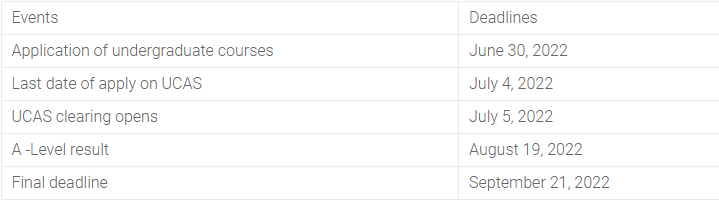
If you want to reserve a space for yourself and avoid falling behind, you must keep track of the deadlines and apply as soon as the application form is published. The important dates associated with September intake in the United Kingdom in 2021 are shown below. Take a look at this:

Universities Offer Courses in September Intake

There are numerous well-established and popular universities in the UK that allow September admission. They are detailed below.  

  1. Aston University: Aston University is a prestigious public research university in the United Kingdom. It is situated in the center of Birmingham, England. The University campus spans 60 acres. Sports facilities, swimming pools, gyms, cafés, and health clinics are available to students on campus. Aside from academic lectures, the institution focuses a great emphasis on hands-on learning for students. Through skill development programs, students are taught dexterity for cutting-edge technology. It is one of the greatest institutions in the UK that accepts September applications.
  2. Coventry University: Coventry University, one of the greatest public universities in the UK, offers a comprehensive range of courses and programs for undergraduate and postgraduate students at all entrance levels. Coventry University, located in one of the world’s top student cities, offers world-class facilities, great education, and the opportunity to do high-quality research.
  3. Durham University: Durham University is the next school on our list of UK schools accepting September applications. Durham Institution was established in 1832 as a public research university. The Guardian University Guide continues to rank it 5th. Durham University’s 560-acre estate is part of the UNESCO world heritage site, making it a beautiful place to study. The school has a wide range of facilities, including large classrooms, well-equipped labs, and large libraries.

Finally, students who miss the September admissions season in the United Kingdom may be eligible for the January intakes in the future. September admissions may be higher in the United Kingdom than January admissions since there are more programs to choose from. In the beginning, there isn’t much of a similarity between the two.

UK Universities Entry Requirements || Masters Programme

Overseas master’s programmes are significantly more intensive and study-focused than undergraduate programs. Furthermore, deciding if a master’s degree in England is right for you is a big decision. On the one hand, you want to get started on your professional path and start generating money as soon as you finish your undergrad; on the other hand, studying for master’s degrees in England may increase your employability.

Qualifications are crucial, of course, but universities base their selections on a variety of variables when deciding who to admit into their postgraduate programmes. Some of these admission criteria will be official educational degrees that you have or intend to have, while others will be your English language abilities and what is mentioned about you in the references that you offer. Many postgraduate programmes, for example, will have quotas – a maximum number of students that may be allowed into the programme.

Let’s take a look at each of these characteristics to determine what the admissions standards are for a postgraduate programme.

Educational Qualification: Whatever postgraduate programme you choose to apply for, you must have, or intend to obtain, a good first or bachelor’s degree before beginning the course. If you wish to be admitted to a doctoral programme, you will almost certainly need or expect to have an excellent master’s degree. Every nation in the globe has its own school system, higher education, and academic degrees, and while there are many parallels across the systems, each is distinct in detail. Many nations currently evaluate degrees using grade point averages (GPAs), which are the average scores obtained across all courses within a degree programme.

Most postgraduate degree programmes do not need you to have professional experience in addition to academic credentials. In other fields, such as medicine, teaching, social work, or business, you are usually required to have two to five years of professional experience before enrolling in a master’s degree program.

English Language Competence

All degree programs in the United Kingdom are taught in English. This means that you must be able to demonstrate that you have a good enough command of the English language to grasp and follow the program, read academic literature in English, and write your assignments and dissertation/thesis in English at an acceptable level.

Each institution has its own basic standards, which you may learn about by visiting the university’s website or reading their prospectus. However, most universities have certain common standards, which are minimum levels attained in globally recognized English language ability assessments.

Statement of Purpose

To apply for a spot on a postgraduate programme, you must complete an application form for each university. Most colleges have a part on their application forms where you are requested to provide a personal statement on why you are applying for the course and why you believe you are a good candidate for the program. It is critical that you make this personal statement stand out and pay close attention to it since it will be carefully examined by the admissions tutor for the programme, especially if there is intense competition for seats on the programme.

Academic Reference

On the application form, you will be requested to provide the contact information for two or three persons who can write a reference for you that supports your application. The most crucial thing is to first examine how the university you’re applying to organizes references, and then to follow their guidelines. One of the most typical reasons for a university not being able to make you a place offer right away is that referees take a long time to provide their references

Research Proposal

If you apply to a PhD programme in many academic areas, you will be applying to work on a research topic that has already been chosen by the department you are joining. A research proposal is just an overview of what you propose to accomplish for your study.

Finally, while most individuals will pursue a master’s degree for the chance for high-quality education and professional progression, consider going a step further and taking advantage of the option to live overseas. A master’s degree in England, like any other postgraduate study, may provide hurdles and barriers, but employers will value it! 

Letting Agents’ Services for International Students

A renting agent’s primary responsibility is to manage properties for private landlords. Responsibilities range from finding renters and collecting rent to full management and accountability. If the house you rent is entirely managed by a rental agent, you may never see your landlord in person (though you have the right to their name, contact details and address). There are various alternatives for obtaining accommodation for international students in the United Kingdom.

● Using a letting agency

● University accommodation

● Searching a private accommodation online

Business of Letting Agents

Letting agencies charge landlords money for these services, and as such, they are contractually obligated to put their customers’ best interests first. Tenants are also charged money for services and, in exchange, are owed a responsibility of care; at no time does this conflict with the landlord’s interests. In other words, a renting agency will not be able to provide tenant advice on any part of the tenancy that may jeopardize a landlord’s position.

Why Should Students’ Letting Agency?

Landlords who utilize letting agents do so because it makes their lives easier. If the home being managed is not in the same area as the landlord, a letting agency might be advantageous. A letting agent’s responsibility is to provide expertise, professionalism, and efficiency to the table.

Furthermore, whether you’re a seasoned landlord with a huge portfolio or a young landlord just getting started, letting agents may provide a lot of peace of mind and assistance. If you’re uncertain about the legalities and compliance obligations of being a landlord, this might be very helpful.

Tenants’ Benefit

Most renters are only concerned with finding the perfect house; however, it is also critical to choose the right renting agency. A little planning and study may go a long way toward avoiding a bad encounter with a rogue letting agency. As an example, as a basic minimum, you should ensure that the letting agency is a member of a professional group. The National Approved Lettings Scheme (NALS), the Association of Residential Letting Agents (ARLA), the UK Association of Letting Agents (UKALA), and the National Association of Estate Agents (NAEA) are all organizations that standardize a code of conduct that must be followed. When tenants’ rights are violated, the agency can be reported to the appropriate regulating body to assist increase standards and settling conflicts.

 Apply for UK University in September Intake

Letting Agents’ Services

Letting agents provide varying degrees of service, so depending on how active you want to be in the property’s administration, there will be a service level that is appropriate for you. They are required by law to post their service level fees in branches and on their website so that customers may compare rates across other agencies. Although each agent is unique, the following are the basic services that most will employ.

Find Out Tenant: This is the most basic level of service, in which the rental agent will locate you a suitable renter. This normally requires taking professional images, designing floor plans, and advertising them in places where they will receive the greatest attention.

Collect the Rent: Rent collection may be included as part of the tenant location service in some cases. The renting agency will collect the deposit and manage the legal obligations for deposit protection, as well as collect the rent from the renter. They will also pursue down any rent arrears, serve notifications, and advise you if renters continue to fail to pay rent.

Manage the Property: The rental agency manages all elements of letting your property, including the services provided for tenant find and rent collection. Throughout the tenancy, they will communicate with the tenant, organizing maintenance, inspections, check-in, check-out, and any deposit disputes.

Documents Needed for International Students

Documents overseas students need to submit are as followed:

●Passport must be current (we will need to view the original document 28 days before your tenancy start date). The right to rent is a legal requirement in the United Kingdom.

●Visa is still valid (we will need to view the original document 28 days before your tenancy start date). The right to rent is a legal requirement in the United Kingdom.

●3 months’ worth of bank statements — from the account where you pay your rent.

●Proof of address must be dated within three months of the commencement date of the tenancy. It must include an issue date.

In the end, if you’re a student searching for a place to live in London, the first step is to locate a student landlord who has a suitable property. You can also contact your institution, which may be able to identify student landlords and housing providers that fit your requirements.

Life of International Students in the UK

In the United Kingdom, you will receive a wealth of fresh experiences, as well as the opportunity to see and discover new locations and make new friends as an international student. The UK is a multicultural country with many customs, and you’ll feel at home sooner than you think. Moreover, a degree from a UK institution is respected around the world, and it allows students to work and live anywhere they want. So, if you are worried about how you can survive your entire academic career without your family, we can assure you that there will be plenty of entertaining people out there because the British are inherently warm, supportive, and understanding. While studying in the UK, you will surely make some friends with lifetime warranties. The factors of student life in the United Kingdom are as followed:   

  1. Student Clubs and Unions: Every institution in the United Kingdom has its own Students’ Union, which is dedicated to providing students with the greatest university experience possible. Throughout the year, they organize multiple fun and interesting events for you to enjoy, as well as hundreds of various organizations and groups that you can join. According to UCAS, many student unions provide a variety of clubs and societies in which you can participate, ranging from street dancing and rowing to marketing and international relations.

Apply to UK universities for September Intake

  1. Make Friends and Settle Down: Moving to a new nation presents a slew of obstacles for those of us who live abroad, ranging from strange cultural peculiarities to finding a place to reside. Meeting new individuals, on the other hand, is one of the most difficult. During your first few weeks in the UK, you will be given a lot of help getting acquainted with your surroundings. Moreover, most UK universities hold special sessions for international students during which staff members show you around the campus and surrounding area. In addition to these, many academic institutions offer Freshers’ Week, which includes parties and events aimed to help you interact with and meet other students. You can make the following moves to make British mates:

●      Make the First Move

●      Join the Parties

●      Become a Volunteer

  1. University Life in the UK: Students from all over the world are drawn to the reputation of a UK university degree. However, data suggest that relocating to the United Kingdom is not always easy. Many people are challenged by unfamiliar systems, cultural differences, and working in a foreign language. Moreover, the academic culture in the United Kingdom is built on active and independent learning, and it employs lectures, tutorials, and group projects. You may be familiar with these, but the information below may be useful.

●      Lectures

●      Tutorials

●      Seminars

  1. Transport System in the UK: Public transportation in the United Kingdom varies from region to region and town to town. The local bus is the most prevalent kind of public transit in the United Kingdom, whether you live in London or a small Welsh village. As a result, it is not surprising that the bus is the most popular means of public transit. If you live and work in London, though, the Tube is almost probably a part of your everyday commute. It is a well-known feature of London life, run by the Mayor of London through Transport for London (TFL).
  2. Food and Recreation in the UK: The United Kingdom is an excellent melting pot of culture, whether you go to a club, restaurant, bar, musical venue, music festival, or show. Cultural events are held on a regular basis by student societies, and independent artists and bands perform in university and college communities. Aside from that, there are museums, exhibitions, historical places, and art galleries to visit. The country is well-known for its literary and performing arts traditions, and numerous theatre performances serve to keep the culture alive.
  3. Accommodation Facilities: As a foreign student, the first and most difficult hurdle will be finding suitable accommodation in the UK. You should start looking for and organizing housing as soon as you are accepted into a programme. Places fill up rapidly, and demand frequently surpasses availability.

●      Halls of Residence

●      Rental Apartment

In the end, as you have seen, student life in the United Kingdom can differ dramatically from one student to the next. The university you attend, the region of the UK in which it is located, and what you do with it all influence your experience. Student life may be both enjoyable and educational, depending on how you approach it.

Ways to Choose the Appropriate UK University

People study abroad for a variety of reasons, including the desire to travel to new places, immerse themselves in a foreign culture, and, perhaps most crucially, to get access to student life and educational opportunities not available at home. If you want to study at a UK university, you will not only have access to some of the most innovative teaching and research, but you will also be part of one of the world’s most diverse student communities. There are specialized universities and colleges throughout the country, as well as world-renowned historic institutions, modern innovative facilities, and pioneering and advanced research centres, allowing you to tailor your education to your desires and job goals.

Choosing the right university and subject might be tough. Before deciding, it is vital that you compare universities. The first step toward a successful career is selecting the correct university. Here are four ways to figure out which university is ideal for you. The following are some methods for choosing the best university in the United Kingdom:

  1. Employment Opportunities: UCAS offers excellent subject guides to assist students in deciding how to select a university course. According to a recent analysis from the UK Department of Education, the UK capital provides a significant wage premium for both graduates and non-graduates. Graduate salaries were greatest in London (£30,400), with the South East and East of England earning more than the rest of the country. The only region with a median income of more than £30,000 in London.
  2. Choose Your Degree Wisely: The first step in deciding on a university is to decide what you want to study. Your UCAS personal statement should be relevant to all of the courses you apply for because it will be sent to all of your university options. This indicates that all of your course options must be the same or in a field linked to your major. Consider the school subjects in which you excel, as well as the subjects in which you may spend the following three or four years studying. Do you want to study something relevant to a certain job, such as law or medicine? Or maybe you’d like to take a class as a history, which may be applied to a range of jobs? If you carefully consider these questions, the rest of the procedure will be a lot easy.
  3. Review the Competition: When choosing a path, it is vital to consider the competitors. Some courses have considerably more applicants than available slots, while there are hundreds of ‘secret’ courses with substantially fewer applicants. According to the University of Oxford, each slot on its Economic Course can attract up to 16.9 candidates. However, the number of candidates per traditional position is closer to three. Classics covers a vast range of themes such as politics, history, linguistics, social sciences, and more, and it truly puts your intelligence to the test. Non-elite universities that have chosen to charge the highest prices, according to analysts, will lose students as a result of these measures.
  4. University Location: Choosing a university means picking where to live, so all of the factors that you would consider when relocating to a new location are equally essential. The proper location can assist you in making the most of your educational experience. Moving to a new location can bring unique experiences that cannot be obtained by staying at home. You may be living independently for the first time, and as a result, you will have a variety of responsibilities. Furthermore, according to UCAS, while selecting a university degree, students should attend an open day to determine if they have a favourable impression of the institution.
  5. Teaching and Research Facilities: It’s a good idea to look at your desired university’s teaching and assessment approaches. Some courses have an emphasis on final exams, while others place an emphasis on coursework, and still, others place an emphasis on projects, dissertations, and independent study. You should also check whether your university’s exams are open or closed. Also, keep in mind that each university’s course website will provide you with information on the course material and how it is scored. You must select which type of examination is best for you.
  6. Look Beyond the Lectures: You’ll most likely be at university for at least three years, so make use of the opportunities offered outside of the classroom. A robust film society may exist at one university, whereas another may have a thriving cocktail club or a winning sports team. “If a university doesn’t offer the society you’re looking for, you can always start one,” Baillie adds.

Finally, several UK institutions are well-known worldwide for their subjects, courses, professors, and tutors. With over 160 universities and institutions to choose from, as well as an endless number of courses and study opportunities, you may personalize your UK higher education experience to be as unique as you are.


Financial Support for Disabled Students in the UK

International students aspiring to study in the UK since the country is home to a large number of famous universities. Furthermore, there is no reason for impaired students in the United Kingdom not to pursue higher education. Despite the fact that studying as a disabled person remains difficult, substantial progress has been made, and the university is now open to everybody. Furthermore, Financial Support for Disabled Students in the UK is mandated by law to offer good care to impaired students while they are enrolled. This involves everything from the most basic necessities, such as wheelchair-accessible roads, to how they will be treated socially. The number of students with disabilities enrolled in higher education in Organization for Economic Cooperation and Development (OECD) countries is small in comparison to their population size, but it is increasing.https://telegra.ph/embed/youtube?url=https%3A%2F%2Fyoutu.be%2FqLlZVtj_AXQ

Studying in the UK as a disabled student will be no different than studying as a non-disabled student since your fundamental rights will be protected and guaranteed by law. Even if you are a foreign student, universities in the United Kingdom are committed to ensuring that these requirements are appropriately implemented and that you have a regular student life.

UK University Support for Disabled Students

We strongly suggest you call your favourite university or institution before enrolling in a UK program to notify them of your needs and to ask them the following questions:

  1. Deaf Students: Is it feasible to seek assistance during lectures and seminars? You may be able to seek assistance from note-takers or obtain lecture printouts. Check to discover if audio induction loop systems are available in lecture halls and classrooms.
  2. Dyslexic Students: Will I be compelled to take a dyslexia assessment? You may be invited to participate in a dyslexia assessment even if you have previously been diagnosed with dyslexia. This will aid the institution in determining what assistance you require and how they can best assist you. You can request an evaluation if you feel you have dyslexia but have never been tested.
  3. Physically Disabled Students: Is it easy to get to campus? Although most institutions have wheelchair-accessible sidewalks around their buildings, certain older facilities may be challenging to navigate.
  4. Sight Impaired Students: What types of tests and study materials are available? You may have access to Braille text, tutor recordings, text-to-speech technologies, transcription services, and magnification software. During exams, you may also be able to seek additional time.

Scholarships for Disability Students in the UK

There are several disability scholarships available around the world that provide financial assistance to students with a physical, sensory, or learning disability, as well as a mental health concern. The following scholarships are offered in the United Kingdom are:

  1. Disability Grants Higher Education: A list of funding, grants, and scholarships available to disabled students intending to study in the United Kingdom.
  2. Flying Scholarship for Disabled Students: A non-profit organization that trains people with disabilities how to fly. You can apply if you are a UK resident over the age of 18, not enrolled in full-time education, and have a DVLA driving license.
  3. Oxford Wadham Graduate Scholarship for Disabled Scholarship: This fellowship is offered to students from the United Kingdom, the European Union, and other countries who intend to study for a master’s degree at Wadham College, the University of Oxford (full-time or part-time). Applicants must demonstrate high intellectual potential, and there is no additional application process – simply submit your graduate study application by the January deadline for your course.
  4. Snowden Trust Grants: The Snowden Trust, a UK-based organization, offers bursaries to students from any country who have physical or sensory impairments who want to study at a UK college or university.
  5. Student Health Association Bursaries: Bursaries are offered for disabled students who were either ineligible or refused the UK government’s Disabled Students’ Allowance (DSA), which is exclusively available to UK students living in England. You must have applied for the DSA and be able to provide the results of your application. You must have started your course before applying for a grant.
  6. British Council Scholarship: There are several UK scholarships and Financial Support for Disabled Students with disabilities and special educational needs, which are run by the UK or international governments, charities, or corporations, as well as UK universities, colleges, and schools.

Finally, some students may discover that the tools provided by a university’s disability office, such as note-taking services or extra time on tests, are sufficient. Others, on the other hand, may require more complete services, such as therapy, a place to live, life skills training, and access to a social network. 

Design a site like this with WordPress.com
Get started