Accelerated Degree || Should You Pursue or Not

What is Accelerated Degree

Two-year accelerated degrees are exactly what they sound like: degree programs that last two years rather than the standard three or four. Furthermore, an accelerated course would cover the same curriculum as a three-year degree and offer the same credential.

Furthermore, while two-year degrees are already available at a few UK universities links to an external site.

The House of Lords has authorized measures to expand their availability beginning in September 2019. This more flexible alternative is intended to attract students who desire a degree but do not want to spend three years at university. There is also a monetary incentive.

Pros of Accelerated Degree

When it comes to advancing your career and securing a high-paying job, and expedited degree is becoming increasingly vital. The following are the benefits of taking this course:

  1. Timeline of the Degree: Students that are highly motivated may wish to explore enrolling in an accelerated bachelor’s degree programme. This strategy allows you to complete the same number of courses in much less time, anywhere between 18 and 24 months. Most accelerated bachelor’s degrees necessitate taking one course every short term and focusing entirely on that subject. You are more likely to understand the coursework chosen because there is no juggling of content for multiple disciplines at the same time. Students in accelerated bachelor’s programmes typically outperform their peers academically since the content is fresher during exams.
  2. Fewer Tuition Fees: Three-year degree programs cost more than accelerated degree programmes. You’ll also save money on living bills – or not have to rely on your parents. How much would a year’s worth of your monthly expenses (groceries, energy, transportation, and rent) cost? What would you do with that much money? Are you planning a trip to South America? Moving out of the house and into a fashionable apartment? Alternatively, how about funding your first entrepreneurial venture?
  3. Start Career Easily: Getting your first job might be difficult. It’s a competitive employment market out there, and finding work can take months. An expedited degree will give you a year’s advantage while looking for jobs. Your experience will be useful when your coworkers enter the workforce. Completing an accelerated degree program may also increase your attractiveness to employers. It signifies that you are committed to your work and are serious about moving up in your profession.

Cons of Accelerated Degree

Accelerated degrees have various advantages, but they also have certain disadvantages. The drawbacks of accelerated degrees are as followed:

  1. Shorter Period of Time: Programmes for accelerated bachelor’s degrees are not for everyone. Condensing a semester’s worth of course information into less than two months may be difficult. Students engaged in accelerated programs must be completely dedicated to their academics. Assignments are completed at a frenetic pace that some students may find intimidating. You’ll have to work twice as hard on your weekly homework. Any major events in the near future, such as a wedding or the birth of a new kid, have the potential to derail your relationship.
  2. Chances to Give Up: The demanding pace of an accelerated bachelor’s programme may force frantic students to drop out. These degrees have a greater dropout rate than their regular counterparts. Certain subjects may be especially challenging to learn in a hurried manner. A rushed schedule for bachelor’s degrees in demanding STEM subjects may not be feasible. Accelerated students may just learn the material, pass the final exam, and then forget about it. Faster courses are associated with lower long-term retention rates.
  3. Tough to Reach the Professor: Accelerated online programmes may admit a greater number of students than standard on-campus programmes. Faculty may just not have enough time to respond to each student’s question. Due to time constraints, one Canisius College study reported that students in five-week courses were less satisfied with their mentorship than students in full-semester courses. Professors in accelerated programmes, on the other hand, are not promised to respond to emails within 24 hours or to deliver assignments on time.

In the end, there is no such thing as a perfect degree. Accelerated degrees are an excellent choice for certain people, but they are not a one-size-fits-all answer. Some pupils may benefit from them more than others. Several UK universities, notably Hertfordshire University, Derby University, and Northampton University, offer two-year accelerated degrees.


Why Study Accounting and Finance in the UK

Intake: January, September

Mood of Study: Full time

Course Length: BSc (3 years), MSc (1- 2 years)

Fee Range: Up to £25000 on an average (approximately)

The United Kingdom is one of the world’s best and most well-known overseas student destinations. Every year, a large number of international students travel to the United Kingdom to further their studies. Accounting and finance degrees offer excellent graduation opportunities as well as the chance to work in some of the most prestigious corporations and accounting practices. Finance studies help you learn and prepare for a business career while also increasing your business awareness. Financial accountants supply all of the abilities needed by businesses and are in high demand, making accounting a fast-growing career option. Accountancy graduates usually have the skills and knowledge to further their careers in other sectors of business.

Reasons to Study Accounting and Finance

Reasons to pursue a degree in accounting and finance can be found below:

➔   Accounting and finance degrees are good options for anyone interested in joining some of the best graduate training programmes. Joining a well-established firm as a graduate trainee offers a more structured training programme as well as greater opportunities for professional advancement and personal development.

➔   The accounting profession is unlikely to lose favour. Every business needs accountants and finance specialists in order to comply with relevant legislation and business procedures. You just need to stay current on changes in the finance business to ensure that you remain a highly valued and marketable employee.

➔   Accountants are the backbone of any commercial or corporate organization. Graduate accountants can work in any industry or sector because their skills and knowledge are transferable.

International Admission Intake and Tuition Fees

Accounting and finance degrees are available at a number of UK universities, including the BSc and MSc levels. A full-time Bachelor of Accounting and Finance curriculum costs between £18525 and £23079. The tuition expenses for the MSc programme, on the other hand, range from £16000 to £28900 for international students.

Benefits of Studying Accounting and Finance

Accounting and finance combine monetary ideas with business and management principles. They encompass a wide range of institutional and organizational reporting, calculation, and assessment activities. Benefits to pursue a degree in accounting and finance can be found below:

  1. Bright Career Path: You will have a variety of professional opportunities after graduating from university with a degree in accounting and finance. You may use your degree to become a chartered accountant, stockbroker, or forensic accountant, or you could follow a completely other road and use it to become a business development manager, data analyst, or mortgage advisor.
  2. Earn Smart Wage: Accounting and finance graduates have the potential to earn high-paying salaries depending on the career path they choose. If you decide to work as a public or private accountant, you can expect to start at roughly £18,000. With further experience and the necessary qualifications, you may make up to £100,000 per year (National Careers Service).
  3. Can Access Every Industry: Choosing a career in accounting and finance means you will have the abilities to work in a field that is always in great demand. Accountants and finance specialists are needed by businesses of all sizes to handle their money. Because accounting and finance degrees are in high demand, you will have many work opportunities.

Career after Studying Accounting and Finance

With a degree in accounting and finance, you will be able to explore a wide range of professional opportunities. Accounting can lead to a variety of jobs, including:

➔   Chartered Accountant: As a chartered accountant, you can work in practically any industry, which means you can combine your profession with something that interests you. You will provide advice, audit accounts, and provide accounting and financial assistance. Typically, you will concentrate on one organization and manage all of its financial needs. As a chartered accountant, you will have numerous options for career advancement and a great earning potential.

➔   Financial Manager: Financial managers are in charge of an organization’s financial health. They create financial reports and devise strategies to assist their firm in meeting its long-term financial objectives.

➔   Financial Advisor: Financial advisors assist their clients in understanding their financial situation and making customized investment decisions. They keep track of their customers’ investments and finances and can advise them on insurance, mortgages, college savings, estate planning, taxes, and retirement.

UK Universities for Accounting and Finance

  1. Newcastle University
  2. Northumbria University
  3. University of Portsmouth

Finally, accounting and finance professionals perform vital roles in businesses of all kinds and shapes, both in the UK and around the world. This degree is appropriate if you wish to pursue a job in accounting or if you are already professionally certified and want to further your education.

Study Social and Health Care at UK Universities

Reason of Study Social Health

The Department of Social and Health Care will provide you with a complete understanding of current health and social care and its application in the broader social, policy, legal, and organizational environment, both in the UK and abroad. Take advantage of this four-year programme, which includes a fee-free one-year placement in an industry where you will get practical experience, improve your CV, and meet potential future employers.

Advantages of Studying Social and Health Care

❖    Understand and confidently apply evidence-based theory to practice, resulting in outstanding health and social care outcomes for all who use these services.

❖    Take the course with a placement year to take advantage of our extensive placement possibilities.

❖    Join a course built in collaboration with industry experts to ensure your studies are up to date and relevant.

❖    Take advantage of the Health & Social Care Academy at UK universities, which is operated in cooperation with local councils and NHS Trusts to recruit and teach health and social care staff.

Intake and Tuition Fees

This programme is offered at a significant number of UK universities, both undergraduate and postgraduate levels. On average, full-time Bachelor’s and Master’s international students must pay £12900-14910 per year.

Career Opportunities in Social and Health Care

Health and social care are a massive service industry undergoing fast development, with new government initiatives elevating it to new heights. As a result of these advancements, there will most likely be a demand for well-trained, multi-skilled individuals. Students of this department can join various sectors. Such as,

❖    Occupational Therapist: Occupational therapists help people whose health prevents them from doing things like getting dressed or doing errands. Occupational therapists must be adept at problem-solving and working collaboratively with others, including their patients and other social and healthcare professionals. They must be computer literate in order to keep correct records.

❖    Rehab Worker: Rehab worker is one of the lesser-known health and social care profession pathways. They assist people in regaining their independence after being unwell or in an accident. Adults with learning disabilities, persons with sight or hearing loss, people with mental health difficulties, or people who use drugs are all supported by rehab staff.

❖    Care Worker: Caregivers help people live more independently by assisting with social and physical activities, organizing appointments, and supporting clients with showering and clothing. You could work with a diverse spectrum of clients, including those with learning disabilities, physical disabilities, substance misuse problems, mental health issues, and the elderly.

❖    Counsellor: Counsellors assist patients in working through tough moments in their lives, such as when they have just lost a loved one or are dealing with a long-term disability. Counsellors assist them in making positive changes and improving their own mental health.

❖    Health Psychologist: People’s awareness and attitude toward health are improved by health psychologists. They assist their patients in making beneficial adjustments in their attitude and behaviour, like cutting back on drinking or eating more healthily. Health psychologists operate in a variety of contexts, including hospitals, municipal governments, and universities.

UK Universities for Social and Health Care

Here are some UK universities which offer the course Social and Health Care. They are:

  1. De Montfort University: You will examine and critically evaluate a wide range of themes that define today’s health scene, with a focus on variables related to wellbeing. Health psychology, health sociology, public health, health promotion, health and social care management, and health inequities will be among the topics covered. You will be able to choose from elective modules such as ageing and health, mental health and wellbeing, and social exclusion and health in year three.
  2. Manchester Metropolitan University: Students will be taught by instructors who have worked as practitioners in a range of health and social care settings. Their researchers’ work attempts to have an impact on real-life circumstances and lives, and they employ cutting-edge research to inform how they teach you.
  3. University of Sunderland: This course will provide you with a critical understanding of integrated health and social care welfare systems and processes, as well as advanced theoretical knowledge and skills in practice and management. Students can enrol in this course on a full-time or part-time basis. The Health and Social Care department focuses on broad health and social care topics and theories, applying them to contemporary issues such as mental health, substance abuse, and domestic abuse.

Finally, as you continue through the course, your option choices expand, allowing you to focus more on your selected fields of study in the final year. 

Essential Hacks to Save Money While Studying in the UK

Essential Hacks to Save Money While Studying in the UK

Studying abroad is a life-altering but puzzling process. The United Kingdom is a highly popular choice for international students to study at globally recognized universities. However, it can cost you a good amount of money, time, and effort. However, an organized and efficient budget plan can help you manage your studying and living expenses more effectively. This is why, before leaving your home country, ensure that you consider expenses like accommodation, food, health insurance, entertainment and travel along with your tuition fee while calculating your total expenses in the United Kingdom. Moreover, living and other expenses in the UK vary on the basis of an individual’s lifestyle and personal circumstances. Some important tips to reduce costs while studying and living in the UK are:

  1. Scholarship or Funding: Tuition fees at UK universities largely depend on the institution and course you’ve enrolled in. Moreover, in the UK, there are many high-ranking universities and colleges with their own fees and structures. The tuition fee also differs depending on the location of your university. Also, the tuition fees depend on the student’s level of degree.

Getting a scholarship or funding from the university or from professors is the common way to reduce your tuition fees. If you get a scholarship you’ll be able to save a large amount of money. UK universities offer a large number of scholarships for both local and international students. You may also contact the Universities representatives. Most of the information you may also get on the university website. The common scholarships are:

★ Commonwealth Scholarship

★ Rhodes Scholarship

★ Fulbright Scholarship

★ The Chevening Scholarship

★ The Global Study Awards

★ The Royal Society Grants

★ Gates Cambridge

2. Student Accommodation vs Living at Home: The accommodation costs vary on a large scale in the UK. Here, most universities provide on-campus accommodation facilities. In addition, cities like London, Nottingham, Manchester are hugely costlier than other cities and small towns. As most UK universities offer accommodation for international students, it should be the most preferred and financially beneficial option for them and as a result, the foreign students can reduce their expenses. Furthermore, living on-campus residency will add conveniences for students as their campuses are just a walking distance away. Moreover, they can save their transportation costs. Also, the students can share their rooms with other students at the very beginning.

3. Public Transport in England: If you’re going to London, England you will discover highly organized public transport and you should take advantage when you’ll be here. You’ll need an Oyster Card to use British public transport. However, it can be difficult for you to identify which option of Oyster Card is more suitable for you. Here’s a breakdown that might be helpful for you.

★ Top up as You Go Card

★ Student Card

★ Monthly Card

4. Grocery and Shopping Places: There are plenty of grocery stores in the UK to choose from, but it is good to know which ones will get you the best deals. Sainsbury’s and Tesco are the cheapest and well known for international students. Students will find everything they need. You need to remember that you’re purchasing all these things only once. So, you don’t need to worry about the cost.

5. Free Entertainment: You will get this good deal of entertainment only in London and finding these things won’t be difficult for you at all. As London is a city to walk around with plenty of fascinating architecture and history, you will never get bored in this city. Moreover, you can visit most of the museums without spending a single penny in England. The United Kingdom also has a large number of parks where you can spend some quality and peaceful time and you don’t need to spend money here as well.

6. Don’t Rush to Buy Books: You might get a shock at the beginning of your academic year when you’ll receive a reading list that might be more expensive than your parents’ house. You need to find out which books you must buy because believe it or not buying these books can be a waste of money. As for the others, if need be, you can always borrow them from the library.

In the end, it is true that international students often get a pretty bad reputation for their questionable money management skills. So, you can start making your plan from now on since you have got an idea of the costs of living and studying in the United Kingdom. Moreover, if you get the opportunity to study in the UK you must miss the opportunity.

Studying Abroad Boost Your Job Prospects

In the span of globalization, the world has become a global village. Moreover, the number of studying overseas universities in this modern period is hugely increasing. Also, studying in a different country can be a lifetime experience for international students. International experience will provide you with opportunities to expand your employment opportunities. Furthermore, if you can include international internships or international work experience that will boost your network both in your study country and in your home country. There are some countries that are globally recognized because of their high-quality education and which is why they attract a large group of international students every year. Also, you can consider the UK at the top of that list.

There are a lot of countries which allure the foreign students’ attention because of their high standard education and teaching system. The place which provides the high ranked education system to the students are:

Benefits of Studying Abroad

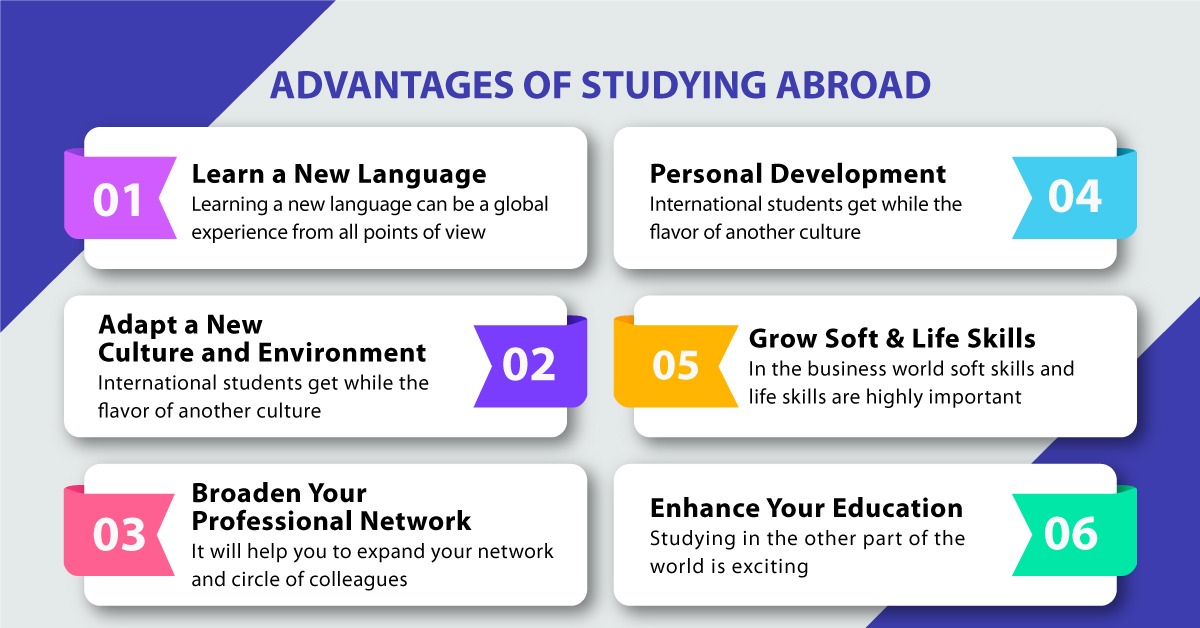
In this competitive world studying at an overseas university will broaden your skills and knowledge, prepare you to solve the world’s toughest challenges. Nowadays it is very important for students whether they will be future innovators, entrepreneurs, managers or leaders. The advantages of studying abroad are: 

  1. Learn a New Language: Learning a new language can be a global experience from all points of view. If you become a master of a foreign language can make you a more attractive candidate for an interesting job. Moreover, knowing a foreign language brings a lot of personal satisfaction, broadening your exposure to information and cultural experience. 
  2. Learn to Adapt a New Culture: One of the biggest advantages international students get while studying at an overseas university is to get the flavour of another culture. British history is one of the oldest in the world. Their traditions, culture, art, museum, and education are world-famous. From the Tower of London and Buckingham Palace to Stonehenge and Edinburgh Castle. There’s a lot to see and explore in the UK especially if it will be your first time here. For example, the Alexandra Palace in London. Furthermore, the international students will also get a taste of a multicultural and multilingual environment. So, if you want to be successful in your chosen career, you will have to become adaptable to change and to diverse cultures and living in a foreign culture will train your adaptability. 
  3. Make New Friends: Studying at overseas universities will help you to expand your network and circle of colleagues and it will help you while seeking opportunities in different markets. It is so obvious that wherever you go to a university you’ll meet new people and make new friends who hold more or less the same position as you. While studying abroad you’ll have a great opportunity to make new friends from different cultures and backgrounds. In the university, you’ll find many lifelong friends with whom you’ll be able to live, learn and travel together during your studies. It can also be highly beneficial to know people from different countries and cultures around the world. 
  4. Personal Development: In many ways, going abroad to study will increase your personal development. There’s no alternative to firsthand experience. Moreover, diving into a new environment is a great way to gain new insights about yourself and to grow on a personal level. In addition, students who spend a semester abroad usually describe the experience as ‘life-changing. It will also assist you to see the world with new eyes and understand it from a different point of view. Also, the well-established global companies highly appreciate this as a positive experience. 
  5. Increase Your Professional Skills: In the business world soft skills and life skills are highly important, yet schools do not always focus on emotional intelligence as part of their curriculum. Moreover, your days at an overseas university will give you the full immersion experience of living in a different country and give you the opportunity to learn that country’s language and culture at social, academic and professional levels. In an overseas country, you’ll have to try something new every day. 
  6. Enhance Your Education: Studying in the other part of the world can be both exciting and interesting. You will get the chance to enjoy being taught in the world’s leading universities and by renowned professors and teachers on a regular basis. Also, it exposes you to different styles of learning, education system and opportunities.

In the end, international students need to go through deep research before finalizing their higher study destination. Moreover, they can take guidelines from authorized experts. So, if you have the opportunity to study at overseas universities, grab the opportunity because it is definitely a worthy decision. Also, when you finish your degree and return to your home country you’ll experience a new perspective on culture, language skills, great education and a willingness to learn.

Information to Gather before Going to the UK

Studying in the United Kingdom can be a lifetime experience for international students. However, it can cost you a good number of pennies and time. The UK is not only famous for its educational institutions but also for its old heritage and tradition, environment, multicultural atmosphere, the standard of living etc. However, if you know each step that needs to be taken and how to prepare your documents, things will become much easier for you. Foreign students need an easy and comprehensive guideline that they can follow step by step. Things you must know before studying abroad are:

  1. Require Visa: The primary thing for international students before going to the UK is to find out whether they require a student visa or not. The students coming from any EU country do not need to apply for a visa but students other than the EU need to apply for a TIER 4 visa in their home country’s British embassy. Moreover, if international students wish to work while studying in the UK, they are advised to apply for the same on their visa beforehand. Another important point to be remembered is that the students from non-EU countries cannot work more than 20 hours a week whereas the foreign students from EU countries have no time limit to work. 
  2. Choose your Study Destination:

At the very beginning of studying in overseas countries is to select the country you want to study. An international student may apply to various countries inside the UK. Such as England, Scotland, Wales and Northern Ireland. The budget and desired discipline have a big impact on where an international student should enrol. Some questions and suggestions might be helpful for foreign students to pick the right destination for them.

3. Choose Your Desired College or University:

It is greatly important for international students to select the right university in overseas countries. It is also one of the most exciting things before studying abroad. Furthermore, each of the overseas graduation schools offers hundreds of different courses and it can be a little difficult for international students to figure out where they want to study. International students need to keep in mind some specific points before selecting a university. Such as,

4. Select Your Desired Degree:

Some students are highly sincere and focused from the very beginning about their career whereas some discover it in the latter part may be during or after high school. However, there are chances that for some students the decision is still not clear even weeks before applying for a degree in overseas universities. In most cases, international scholars always choose one of the most popular disciplines. These highly acceptable fields guarantee that the students will be able to secure their position in the job market both in overseas countries or in their home countries. Some most popular and renowned courses for international students in the United Kingdom are:

● Computer Science and IT

● Business Management and Finance

● Engineering

● Law

● Medicine

● International Relation

● Bio-Psychology

● International Development Studies

  1. Find Out the Cost and Proceed

The first thing students need to consider while selecting their prospective country and desired university is the cost. Students need to be well aware of the tuition fees, accommodation costs, national health surcharge, mobile bill, internet, socializing, day trips, transportations, books and other course materials while living in the UK.

2. The weather in the United Kingdom:

The students who are already living in the United Kingdom believe that the weather in the UK is not so pleasant. International students will discover that in that cold weather people are enjoying outdoor activities, going for walks in the parks when it’s raining. On the other hand, in sunny weather, you won’t find the British sitting inside.  

In the end, if you’re want to go abroad you’re about to start a new and difficult chapter of your life which will be highly interesting, fun, and empowering. Additionally, at the end of it, you’ll be a much better person with some wonderful memories.

Apply and Sustain Admission for Master’s Degree at UK Universities

Studying for a Master’s degree or MBA at UK universities is a fantastic opportunity both for students’ academic and personal life. Students will get a huge choice of the world’s renowned institutions at which to study. Also, they’ll be able to immerse themselves in the British’s old and rich culture. However, it takes both time and effort to apply to any Master’s programme in the UK. A large number of UK universities have their own application deadline. On the other hand, a few universities accept applications throughout the year. Also, it is highly important to apply early which will increase your chance to get admission. Moreover, if you want to secure a scholarship or funding, university accommodation, Funding deadlines for courses beginning in September typically fall between January and March, and you’ll be more likely to receive your preferred accommodation the earlier you apply.

We’ve discovered some essential points to secure admission at UK’s top universities for Master’s/ MBA programmes. They are: 

  1. Choose Universities are Accepting Admission: We believe in this stage, you’ve done your research and found the course of your dreams at UK universities. Firstly, international students need to check whether the seats are available and the applications are still open or not. Moreover, as international students, you need to bear in mind that deadlines for applications are typically earlier for foreign students.

  1. Apply as Early as Possible: If your desired course or university is still accepting applications that would be great news for you. It’s so alluring to wait before making your university application. However, the sooner you apply to UK universities the better it would be. If international students apply at the very beginning they will get more time to process the application, submit all their academic documents, and a statement of purpose. Post-graduation courses in the UK are vastly different from undergraduate degrees. The undergraduate courses are processed through UCAS but there’s no centralized application system for master’s courses. As a result, students have to apply to each university separately. 
  2. Supporting Documents: Prospective master’s students need to submit a cover letter, a CV, all academic certificates, English language test scores along with their application form. Furthermore, each UK university differs at the master’s level. However, the requirements should be clearly demonstrated on the university website. As the United Kingdom practices English as their first language, international students need to prove their English language proficiency, if English is not their first language. 
  3. Deadline of Funding and Scholarship: As you got to know prior UK universities might have different deadlines for their master’s programme, you also need to know that the deadline for scholarship also varies from university to university, even from department to department. Additionally, the deadline for funding closes before the main application deadline. As a result, the students need to be more careful who are seeking scholarships or funding. On the other hand, for some research programmes, the funding comes from the professors. As these assessments take time, students should apply by considering these things. 
  4. Key Deadlines in Your Calendar: Students can maintain a calendar to maintain the deadlines, documents list, and other things related to university admission. Students can keep an eye on these

➢ Deadline for submitting the application form and necessary documents (both academic and other). You need to make sure that you have all the paperwork in advance. 

➢ You need to keep a record of the deadline for responding to your offer. Nothing can be worse than getting an offer but missing the deadline.

➢ Students also need to remember the dates of paying the application fees and tuition fees (if applicable). 

➢ As accommodation is highly crucial for international students they might need to pay the accommodation fees in advance. 

Essential Documents for Master’s Programme

Although the requirement may vary depending on your university and course, some common documents need to be submitted for all master’s programmes at UK universities. Those are: 

➢ Statement of Purpose

➢ Academic transcripts and certificates

➢ Two to three references (academic and professional) 

➢ A complete CV of the applicants

➢ A portfolio (required especially for creative degrees)

➢ A research proposal (required especially for Masters in Research programmes)

➢ Proof of your English Proficiency Test (EPT) score (if English is not your first language)

In the end, the students need to submit any form or documents which can prove them as genuine students. If any document is not in English but necessary, they need to translate it into English before submitting it. 

Facts that Make the UK a Popular Study Destination

Studying at an overseas university is a phenomenal experience for an international student. The United Kingdom (UK) is one of the outstanding and globally recognized destinations for international students. A large number of foreign students fly to the UK for higher studies every year. Moreover, the UK is not only prominent for its educational institutions but also for its old heritage and tradition, environment, multicultural atmosphere, the standard of living, etc. There are a lot of reasons which make the UK a popular choice for international students. 

  1. Globally Certified Education: The UK has a reputation around the world as a place of learning and academia and it is also the home of some top-notch universities which is why foreign students want to pursue their higher studies in the UK. Moreover, these universities have kept their reputation for centuries. The University of Oxford and the University of Cambridge were ranked first and sixth out of 1500 universities around the world (THE). The other top-class universities in the UK are:

★     Imperial College, London (8th)

★     University of Bristol (9th)

★     University College, London (10th)

★     The University of Edinburgh (187th)

★     London School of Economics (27th)

  1. Multiple Choice of Degree: There are a number of opportunities for international students in UK universities coming from any academic background. The students can study from Engineering to Medicine and from Business to Humanities and Social Science. The most desired courses of international students in the UK are:

★     Engineering and Technology

★     Medicine and Life Science

★     Natural Science

★     Business Administration

★     Arts and Humanities

★     Social Science

  1. Course Duration: One of the biggest advantages of studying in the UK is that international students can get high-quality education in a very short period of time compared to the rest of the world. On the whole, the duration of masters’ programmes is one year in the UK which means students can complete their graduation faster than others.
  2. Affordable Tuition Fees: As you already know that the duration of the course in the UK is shorter than any other English country in the world, the tuition fees become low here. Moreover, short-duration courses also reduce the living expenses overseas compared to the other study destinations like the United States, Canada, and Australia. Moreover, the tuition fees are actually low in the UK compared to other English-speaking countries.
  3. Scholarship and Funding: UK universities offer a wide range of scholarships for both local and international students. In the UK foreign students mainly get 2 types of scholarships. Such as,

★     Need-Based Scholarship

★     Merit-Based Scholarship.

These scholarships cover students’ university tuition fees, accommodation, and sometimes learners’ other financial issues.

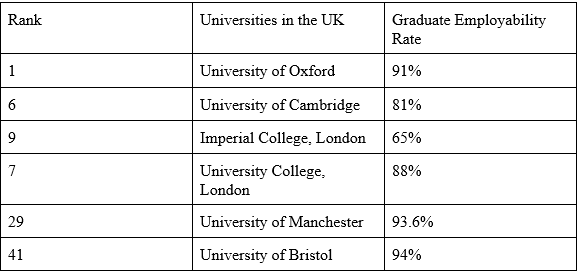
  1. Employability Rate: The employment opportunity rate for international students is pretty high in the UK compared to other English-speaking nations. The list of UK graduate employability is:
  1. Multicultural and Multilingual Society: British history is one of the oldest in the world. Their traditions, culture, art, museum, and education are world-famous. From the Tower of London and Buckingham Palace to Stonehenge and Edinburgh Castle. There’s a lot to see and explore in the UK especially if it will be your first time here. Furthermore, the international students will also get a taste of a multicultural and multilingual environment.
  2. Work while Studying: It is known to everyone that international students need to pay a large amount of money in English speaking countries. As a result, it is highly beneficial for foreign students if they can work along with studying. Moreover, the UK government allows international students to work up to 20 hours at the time of studying.
  3. Life Outside Campus: The UK universities promote and encourage the wholesome development of students’ personalities. The UK can be the best destination for those students who are interested in extracurricular activities. The courses blend perfectly with the activities and vocational skills along with academics to help the overall growth of the students.
  4. Learning and Living a Language: At the time of studying in the UK, foreign students have a wonderful chance to flourish their English proficiency. As the United Kingdom practices English as their first language, international scholars need to enlarge their English skills for their own survival.

In the end, foreign students have a lot more reasons to pick the UK for their higher studies destination along with the above causes. So, if you have the opportunity to study in the UK, grab the opportunity because it is definitely a worthy decision.

Grounds for Cloud Computing’s Popularity in the UK

Cloud Computing

Cloud Computing is a regular phrase for anything that involves delivering hosted services over the internet. It is one of the branches of computer science that covers the management, storage, and processing of data on a network of remote internet servers. Moreover, Cloud Computing is the future of information storage. The main objective of Cloud Computing is to make companies build large server rooms to securely store their data.

History of Cloud Computing

Since the early 2000s Cloud Computing has been introduced as a term. However, the concept of Cloud Computing is much old. The services of ‘time-sharing’ were largely overtaken by the rise of the PC which made owning a computer much more affordable and then in turn by the rise of corporate data centres where companies would store vast amounts of data.

Importance of Cloud Computing

According to the research of IDC, building the infrastructure to support Cloud Computing now accounts for more than a third of all IT spending globally. At the same time, while spending on traditional, in-house IT continues to slide as computing workloads continue to move to the cloud, whether that is public cloud services offered by vendors or private clouds built by enterprises themselves.

Category of Cloud Computing

This service has been divided into three categories. Such as,

● Infrastructure as a Service (IaaS): It is the most open-minded type of cloud service for organizations. The organizations that use this cloud want to do a lot of customization. The most advantage of this cloud is its extra capacity.

● Platform as a Service (PaaS): This cloud uses to build blocks for creating software including development tools. The vendors take care of the back-end concerns. Such as security, infrastructure with PaaS. As a result, the users can focus on building, hosting, or testing apps faster and at a lower cost.

● Software as a Service (SaaS): It is the common type of cloud compared to the other two and it delivers complete applications over the internet. It does not require a lot of time to save technical staff as the users do not need to download or instal on each individual’s computer.

Types of Cloud Computing

  1. Public Cloud: This is a type of cloud computing in which the cloud service providers make computing resources. Moreover, these resources might be accessible to everyone without spending a single penny or the access might be sold on the basis of subscription-based or pay based on the use. Over the past few years, the international market for public cloud computing has grown rapidly.
  2. Private Cloud: This cloud is made only for one user and the access of it is kept highly restricted. Private cloud gets many of the benefits of cloud computing. Such as elasticity, scalability, and ease of service delivery.
  3. Hybrid Cloud: The main objective of this cloud is to establish a mix of public and private clouds. The characteristics of a hybrid cloud can be complicated and confusing. Also, the requirements can differ according to the users

Advantages of Cloud Computing

The advantages of cloud computing are:

● If the data is stored in the cloud, it is easier to get back up and restore that file from the cloud.

● The applications of the cloud develop its collaboration by allowing groups of people to quickly and easily share information.

● Users can easily access the information stored in the cloud by using an internet connection.

● Organizations can reduce their hardware and software costs by using the cloud.

● One of the biggest benefits of cloud computing is the security of data. Cloud offers some advanced features to its user to protect their valuable data and documents.

Disadvantages of Cloud Computing

The disadvantages of cloud computing are:

● As the data is stored in the cloud, you cannot access them without having an internet connection.

● The users may face problems while moving their services from one vendor to another as different vendors provide different platforms.

● The cloud users have less control over the function as the infrastructure is completely owned, managed, and monitored by the service provider.

Study Cloud Computing in the United Kingdom

The UK universities that offer Cloud Computing degrees are:

● University of Leeds

● Newcastle University

● Nottingham Trent University

● University of Leicester

● Middlesex University

In the end, if you are interested in BSc/ MSc in IT Security and want to demonstrate your career in this field then one of these universities will be the foremost destination for you.

Top 10 Affordable University in the UK for International Students

Studying in a different country can be a lifetime experience for international students. However, it can cost you a good number of pennies and time. Additionally, the tuition fee for foreign is quite high compared to the British and EU students. Fortunately, there’s a lot of universities in the UK whose tuition fee are highly affordable for international students. Although the tuition fee of these institutions is low, they are highly popular and well recognized. The Affordable universities for international students in the UK are:

  1. Anglia Ruskin University: The University was established as an Art School in the year of 1858. The art school became Anglia Ruskin University at the heart of the UK’s modern-day campus in Cambridge. International students need to pay £13900- £16700 depending on course and degree. The university offers MBA scholarships both for its local and foreign students. The amount of the scholarship is £4000. The students can also achieve International Excellent Scholarship, a large number of merit scholarships along with the above one.
  2. Aston University, Birmingham: Aston University is a reputed university in the UK for public research. Established in 1966, the university campus is situated in the center of Birmingham on a lush, 60-acre, self-contained site. The University of Aston is a globally recognized hub for education and research activities. The international tuition fee range is £13,900-19,950. However, the university is committed to helping the most creative and hard-working students by offering a variety of scholarships to help minimize tuition and living costs to achieve their potential.
  3. Bangor University: Bangor University was established in 1884 in Bangor city. The city is situated in North West of London. More than 2,500 students who come from over 100 foreign countries are studying at this university. Also, the university is highly popular for its Engineering, Science, and Business schools. The tuition fee for international students is £12500- £15000 depending on the course and the level of degree. The institution provides several scholarships for international students with the Bangor International Scholarship which is one of their most popular ones.
  4. Birmingham City University: Birmingham City University was founded in 1843, but achieved university status in 1992. The university is known for its art and design, health, and media and communication department. The objective of this university is to provide students with opportunities to succeed in the future. The international learners need to pay approximately £12000- £15500 depending on their level and duration of the degree. However, the university offers various scholarships for both local and foreign students.
  5. BPP University: The university is a private institution which was known as BPP College of Professional Studies. The university also offers multiple scholarships for its brilliant brains. Also, the faculty members of this university are a mixture of industry practitioners and experienced academics.
  6. Brunel University London: Brunel University is a public research university situated in London. The university has achieved 121st ranked according to the Times Higher Education (THE). The institution is organized into three colleges and three major research institutes. The university is also known for producing skilled international graduates, equipped with practical understanding in their professional fields. At the same time, the students are benefited from internationally recognized research, delivered by experts, with the essential understanding of practical workplace requirements.
  7. Cardiff Metropolitan University: This is a public university established in 1865. According to the Complete University Guide, Cardiff Met is ranked among the best modern universities in the UK. The international students can expect to pay £12000- £13500 depending on their course and the duration of their degree. The university offers various scholarships for excellent academics and students of this institution.
  8. Coventry University: The university started back in the year 1843 with the name of Coventry College of Design. Coventry University provides globally recognized education and concentration on applied research. The university has been ranked at the 15th position in the UK according to the Guardian University Guide 2020. International scholars have to pay around £13250- £17200. The university provides a wide range of scholarships to eligible candidates.
  9. De Montfort University: De Montfort University is popularly known as DMU is a public university situated in Leicester, England. The university is proud to be ranked Gold in the Teaching Excellent Framework (TEF), 2017. Here, the international students will receive a wide range of professional work experience through DMU works and international exposure through DMU global. International students need to pay £12250- £17280 on the basis of their course and duration of their degree. However, the institution offers numerous scholarships for international students. Such as DMU International Scholarship (£1500), Global MBA International Fund, International Postgraduate Taught Merit Scholarship, etc.
  10. London South Bank University: London South Bank University (LSBU) is one of the largest educational institutions in London. The university has established in 1892 and earned full university status in 1992. LSBU provides a first-class infrastructure and offers excellent academic, recreational, and residential facilities. International students can expect to pay £13125- £14800. However, London South Bank University has committed more than £1 million to its international scholarship scheme.

In the end, studying abroad is a life-changing but confusing process. Moreover, at the end of your study you’ll be a much better person with some wonderful memories.

Design a site like this with WordPress.com
Get started